
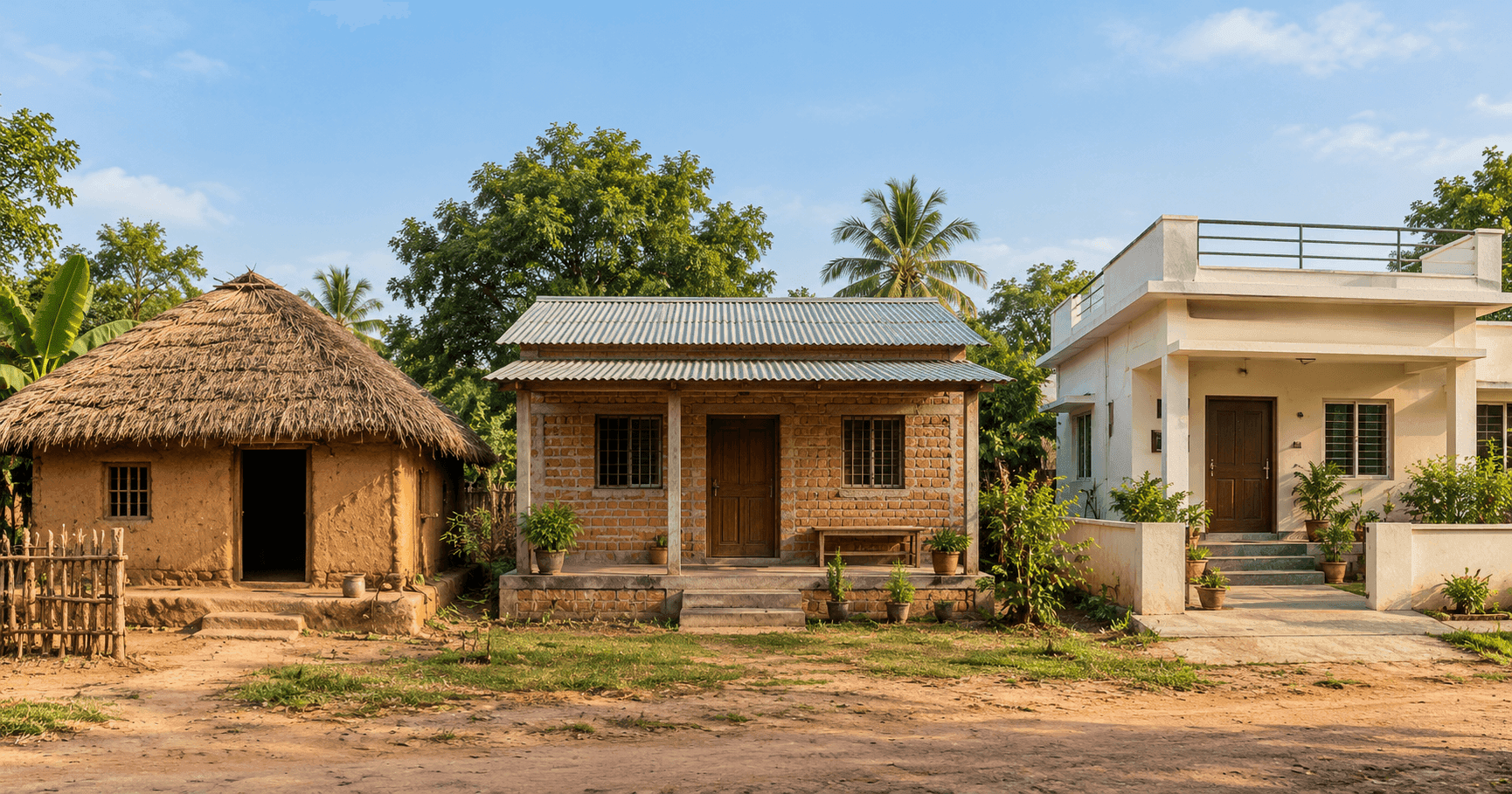
Kutcha, Semi-Pucca, and Pucca Houses: Understanding Structural Differences & How They Impact Your Home Loan
TABLE OF CONTENTS
- 011. What is a Kutcha House?
- 022. What is a Semi-Pucca House?
- 033. What is a Pucca House?
- 04At-a-Glance Comparison: Kutcha vs. Semi-Pucca vs. Pucca House
- 05How Property Structure Impacts Your Home Loan
- 06Government Housing Schemes: PMAY & Structural Eligibility
- 07Upgrading Your Structure with BASIC Home Loan
Explore the materials, durability and key differences between Kutcha, Semi-Pucca and Pucca houses. Understand how property structure can influence home loan eligibility and financing options with BASIC Home Loans.
When planning to buy, build, or renovate a home in India, understanding housing classifications is more than just an architectural lesson, it directly influences your financial options. Lenders, housing finance companies, and government welfare programs like the Pradhan Mantri Awas Yojana (PMAY) classify homes based on their structural durability.
Whether you are seeking a Home Construction Loan, a Property Extension Loan, or checking your eligibility for government subsidies, the structure of your property determines your loan approval status, loan-to-value (LTV) ratio, and property evaluation.
In this guide, BASIC Home Loan breaks down the key structural differences between Kutcha, Semi-Pucca, and Pucca houses and explains how each structure impacts your home loan application.
1. What is a Kutcha House?
A Kutcha house is a temporary or semi-permanent structure built using organic, non-durable materials naturally sourced from the surroundings. These structures are common in rural areas and informal urban settlements.
Key Characteristics:
Building Materials: Mud, unburnt bricks, bamboo, thatch, straw, reed, grass, or loose timber.
Durability: Low resistance to extreme weather conditions like heavy rains, floods, or storms.
Lifespan: Short; requires frequent seasonal maintenance and structural repairs.
Maintenance: High upkeep cost and continuous physical labor needed to maintain wall integrity and roofing.
2. What is a Semi-Pucca House?
A Semi-Pucca house falls between a Kutcha house and a Pucca house. It combines durable structural elements with temporary or semi-durable roofing or wall materials.
Key Characteristics:
Building Materials: A mix of permanent materials (like burnt red bricks, stone, or cement mortar for walls) combined with semi-permanent roofing (Asbestos sheets, tin/metal sheets, or clay tiles).
Durability: Moderate durability; handles mild-to-moderate weather conditions well but lacks full reinforcement against major climate events.
Lifespan: 10 to 20 years with periodic roof maintenance and wall plastering.
3. What is a Pucca House?
A Pucca house is a permanent, solid residential structure engineered using high-strength, weather-resistant materials. These buildings conform to municipal building codes and safety regulations.
Key Characteristics:
Building Materials: Reinforced Cement Concrete (RCC), burnt bricks, stone blocks, steel/iron rods, cement mortar, timber, and high-grade tiles.
Durability: High resilience against severe weather conditions, natural disasters, and structural wear.
Lifespan: 50+ years with minimal routine upkeep.
Types: Standalone bungalows, multi-story apartments, gated villas, and builder floors.
At-a-Glance Comparison: Kutcha vs. Semi-Pucca vs. Pucca House
Feature | Kutcha House | Semi-Pucca House | Pucca House |
Primary Wall Material | Mud, thatch, unburnt bricks | Burnt bricks, stone blocks, cement | Burnt bricks, concrete blocks, RCC |
Roofing Material | Straw, bamboo, leaves | Asbestos sheets, tin sheets, clay tiles | RCC slab, concrete, heavy roofing tiles |
Structural Durability | Low | Moderate | High |
Average Lifespan | 1 to 5 years | 10 to 20 years | 50+ years |
Weather Resistance | Poor | Moderate | High |
Maintenance Cost | Frequent & high relative to structure | Periodic maintenance needed | Low routine maintenance |
How Property Structure Impacts Your Home Loan
Financial institutions, banks, and Housing Finance Companies (HFCs) perform strict legal and technical evaluations of a property before sanctioning a loan. The structural classification directly dictates the risk profile of the collateral.
1. Home Loans for Kutcha Houses
Lender Risk Assessment: Banks generally do not offer mortgage loans or traditional home loans against Kutcha houses because the collateral lacks structural longevity and marketable security value.
Alternative Financing Options: If you currently own a Kutcha house and want to construct a solid concrete structure, you can apply for a Home Construction Loan or a Plot plus Construction Loan. Banks finance the construction of a new Pucca house on plot land owned by you.
2. Home Loans for Semi-Pucca Houses
Lender Risk Assessment: Lenders evaluate Semi-Pucca houses on a case-by-case basis. While approval is possible, financial institutions mitigate risk by reducing the maximum loan amount.
Lower Loan-to-Value (LTV) Ratio: Instead of funding 80%–90% of the property value, lenders may restrict funding to 50%–60% of the property value.
Shorter Loan Tenures: Because the structural lifespan is shorter than that of an RCC concrete home, loan repayment tenures are often capped at 10 to 15 years instead of 20–30 years.
3. Home Loans for Pucca Houses
Lender Risk Assessment: High approval rate. Pucca houses serve as prime collateral for financial institutions.
Maximum LTV Ratio: Borrowers can secure the maximum allowed LTV ratio (up to 80%–90% of property market value).
Flexible Repayment Tenures: Lenders offer extended repayment tenures of up to 20 to 30 years, yielding lower Monthly Installments (EMIs).
Competitive Interest Rates: Lower risk for the lender translates into lower interest rates and smoother processing.
Government Housing Schemes: PMAY & Structural Eligibility
Under government initiatives such as the Pradhan Mantri Awas Yojana (PMAY) / Housing for All, eligibility often centers on transitioning families from Kutcha or Semi-Pucca homes into all-weather Pucca houses.
Construction & Enhancement Subsidies: Beneficiaries owning a Kutcha or Semi-Pucca structure can apply for central assistance or interest subsidies to convert their dwelling into a fully certified Pucca house.
Mandatory RCC Requirement: To qualify for housing scheme completions and bank clearances under PMAY, the constructed unit must feature a permanent RCC (Reinforced Cement Concrete) roof and cement mortar walls.
Upgrading Your Structure with BASIC Home Loan
If you plan to upgrade a Kutcha or Semi-Pucca structure into a durable Pucca house, or if you need a Home Construction Loan on your ancestral plot, BASIC Home Loan simplifies the financing journey:
Compare Multiple Lenders: Access home loan offers from over 35+ partner banks and HFCs tailored to Tier-2, Tier-3, and rural property profiles.
Hassle-Free Technical Verification: Get expert guidance through property valuation and technical verification requirements.
End-to-End Assistance: From document pickup to loan disbursement, BASIC Home Loan advisors assist at zero service cost.